
On this page
- Why put guards on gutters in Katy?
- Which gutter guard types are there?
- Which guard suits which Katy house?
- How should gutter guards be fitted?
- What do gutter guards cost?
- What maintenance do guards still need?
- Related pages
- How does the spring live oak drop affect guards?
- What should be fixed before guards go on?
- Do guards help in tropical storms?
- Can I fit guards myself?
Why put guards on gutters in Katy?
Katy was built on open prairie. Nottingham Country, one of the area's first large subdivisions, went up from the mid-1970s on land that was then treeless. Fifty years on, the trees planted with those streets, and with the communities that followed, stand over the roofs. Live oaks drop leaves and catkins in spring, water oaks and other hardwoods shed in fall and winter, and pines drop needles all year. Together they pack a gutter with a wet mat that narrows the outlets.
That matters because of how rain falls here. NOAA's normals put Katy's average at about 50 inches a year, and much of it arrives in short, heavy storms. A gutter that is half full of leaves overflows at exactly the moment you need it most. Katy Gutter Guys connects callers with independent local gutter contractors, who give the estimates and do the work, including guard installation.
Which gutter guard types are there?
| Type | How it works | Good under | Weak points |
|---|---|---|---|
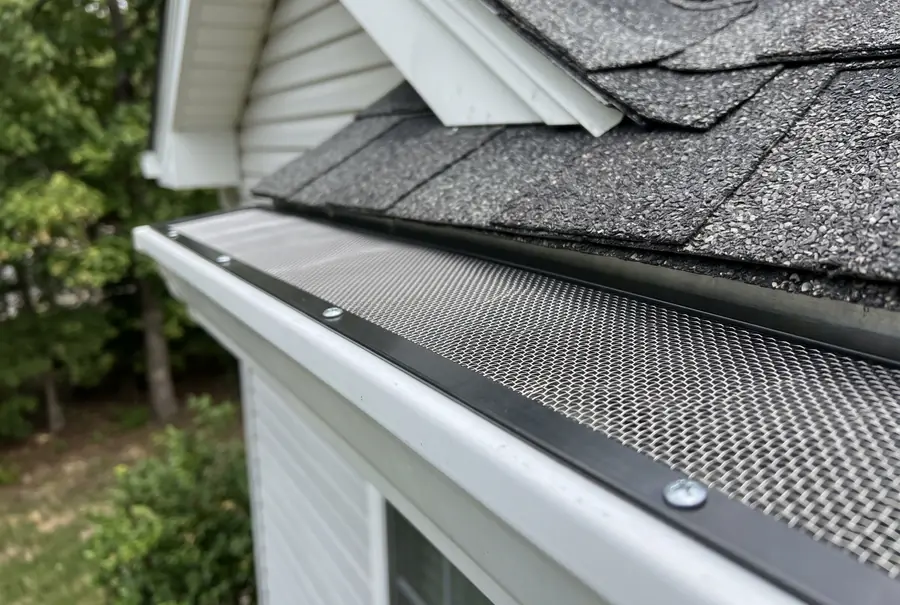
| Stainless micro-mesh | Fine mesh on a rigid frame lets water through and keeps nearly everything out | Oaks, pines, catkins, shingle grit | Highest cost; mesh needs rinsing |
| Perforated aluminum screen | Sheet with holes; stops leaves | Broad leaves | Needles and catkins pass or lodge |
| Plastic or wire screen | Clip-in grid | Low budgets | Sags, cracks in sun, lets small debris through |
| Reverse curve (hood) | Water follows a curved lip into the gutter; debris slides off | Broad leaves | Can overshoot in heavy rain; visible |
| Foam or brush inserts | Fill the trough | Short-term fixes | Hold debris; break down in heat |
See micro-mesh gutter guards and screen and reverse-curve guards for more on each.
Which guard suits which Katy house?
| House | Usual guard | Why |
|---|---|---|
| Older home under big live oaks | Stainless micro-mesh | Catkins and small leaves get past screens |
| House near pines | Stainless micro-mesh | Needles fall all year |
| Newer home with young trees | None yet, or screens on the worst runs | Little debris for now |
| Two-story home, hard to reach | Micro-mesh | Saves risky ladder work |
| Rural property with big hardwoods | Heavy-duty mesh or screens | Large leaf volume |
How should gutter guards be fitted?
- Clean and inspect first. Guards go on a clean, sound gutter. Leaks are sealed and sags fixed before anything is fitted.
- Confirm the pitch. A guard on a run that holds water will collect silt underneath.
- Check the hangers. Screw-in hangers at close spacing carry the extra weight and the debris on top.
- Match the roof. Guards slide under the first course of shingles or fix to the gutter lip, depending on the type and the roof warranty.
- Leave the outlets accessible where possible, so a downspout can be checked.
- Test with water to see that it enters the gutter rather than running off the front.
What do gutter guards cost?
Price depends on the guard type, the length of gutter, the height of the house and whether the gutters need repair first. Micro-mesh systems cost the most per foot and plastic screens the least. A contractor's written quote, per foot and in total, is the real figure. When comparing quotes, check whether cleaning and minor repairs are included and what warranty applies, in writing.
What maintenance do guards still need?
- Brush or rinse the mesh once or twice a year, more under pines.
- Look at the downspouts after big storms; shingle grit and seeds can still collect at the outlets.
- Check after high winds that the guards are still seated.
- Keep the trees trimmed back from the roof so limbs do not rest on the guards.
The guide are gutter guards worth it? weighs the cost against years of cleaning.
Related pages
- Micro-mesh gutter guards
- Screen and reverse-curve guards
- Gutter cleaning
- How often to clean gutters
- Gutter installation
How does the spring live oak drop affect guards?
Live oaks drop most of their old leaves and long pollen catkins in a few weeks in late winter and spring. On a screen guard, catkins drape across the holes and small leaves wedge into them, so water sheets off the top in the next storm. On micro-mesh, the same debris sits on top and dries, then blows off or brushes away. That difference is the main reason micro-mesh is the usual recommendation under live oaks, and why a quick rinse of the mesh after the spring drop keeps it working through the summer storms.
What should be fixed before guards go on?
| Problem | Why it matters with guards |
|---|---|
| Sagging runs | Water and silt collect under the guard |
| Leaking corners | Hidden under the guard, they go unnoticed |
| Spikes | Guards add weight; spikes pull out |
| Soft fascia | Hangers cannot hold the added load |
| Undersized outlets | Guards do not add capacity |
Do guards help in tropical storms?
They help keep outlets open when storms strip leaves and twigs from trees, which is when blocked gutters overflow worst. They do not add capacity, and in the heaviest bursts some water can sheet over any guard. Close hanger spacing and secure front fixings keep guards in place in high winds. After a storm, check from the ground that guards are still seated.
Can I fit guards myself?
Some screen and mesh products are sold for do-it-yourself installation. On a single-story house with sound gutters, that can work. On two-story homes, under heavy trees or with complex roofs and valleys, a contractor's fitting usually performs better and avoids roof damage.