
On this page
- When are guards worth it?
- Why do Katy trees matter?
- How do guards handle Katy rain?
- How do the costs compare?
- Which guard type?
- What should a guard installation include?
- Related pages
- What does a worked comparison look like?
- What do guards not do?
- How do I know a guard was fitted well?
- When should guards wait?
- Are there downsides in Katy's climate?
When are guards worth it?
Katy Gutter Guys connects callers with independent local gutter contractors, who give the estimates and do the work. Guards make the most sense when several of these are true:
| Factor | Points toward guards |
|---|---|
| Trees overhang the roof | Yes |
| Live oaks or pines | Strongly yes |
| Two-story home | Yes |
| Gutters need cleaning three or more times a year | Yes |
| Overflow in storms despite cleaning | Yes |
| Young trees or no trees | No, not yet |
| Single-story home you clean yourself | Maybe not |
Why do Katy trees matter?
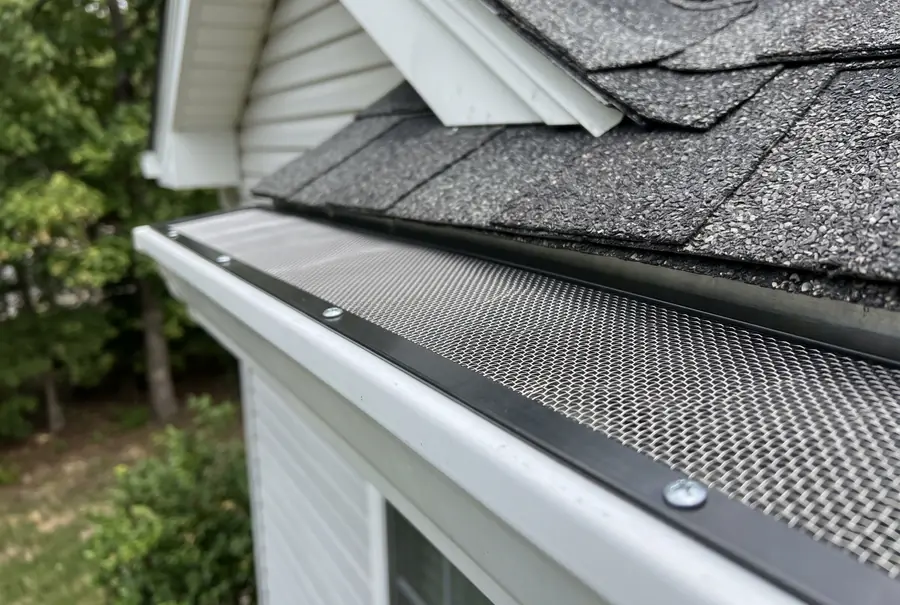
Katy's oldest planned communities, such as Nottingham Country, were built from the mid-1970s on treeless prairie. The live oaks and other trees planted then now overhang the roofs, and the same is happening in the 1990s and 2000s sections of Cinco Ranch. Live oaks drop catkins and small leaves in a heavy spring burst; pines drop needles all year. Both pass through or lodge in screens. Micro-mesh keeps them out.
How do guards handle Katy rain?
NOAA's normals put Katy's average rainfall at about 50 inches a year, much of it in heavy storms. A gutter full of leaves overflows in exactly those storms, so guards that keep the trough clear help most when it matters. In the most extreme bursts, water can sheet over any guard, which is why outlet and downspout size still matter. Reverse-curve hoods are more likely to overshoot in heavy rain than mesh.
How do the costs compare?
Compare the cost of guards with the cost of cleaning over several years:
- Cleaning: the number of cleanings a year times the price of each, higher on two-story homes.
- Guards: a one-time cost per foot, plus light maintenance.
- Avoided damage: fewer overflows mean less fascia rot and less water at the slab.
On a two-story home under mature oaks that needs three cleanings a year, guards often pay for themselves within a few years. On a single-story home with young trees, cleaning once or twice a year is usually cheaper.
Which guard type?
| Guard | Stops catkins and needles | Heavy rain | Durability |
|---|---|---|---|
| Stainless micro-mesh | Yes | Good when clean | High |
| Perforated aluminum | Partly | Good | Good |
| Plastic screen | No | Good | Poor in sun |
| Reverse curve | Partly | Can overshoot | Good |
| Foam insert | No | Fair | Poor |
See micro-mesh gutter guards and screen and reverse-curve guards.
What should a guard installation include?
- Cleaning and repair of the gutters first.
- Close hanger spacing, about every 2 feet.
- A fixing method compatible with the roof.
- Neat corners and valleys.
- A water test.
- Any warranty, in writing.
Related pages
What does a worked comparison look like?
Take a two-story home with 220 feet of gutter under mature live oaks, needing three cleanings a year to keep the outlets clear.
- Without guards: three cleanings a year at a two-story price, every year, plus the cost of any overflow damage between visits.
- With micro-mesh guards: a one-time cost per foot for 220 feet, plus one rinse or brushing a year.
Divide the one-time guard cost by the yearly cleaning saving to see how many years the guards take to pay back. Under heavy trees on a tall home, that is often a few years. Under young trees on a single-story home, it can be longer than the guards will last.
What do guards not do?
- They do not fix sagging, leaking or undersized gutters. Those are repaired first.
- They do not end all maintenance. Mesh still needs rinsing; outlets still need checking.
- They do not stop extreme overflow. In the heaviest bursts, some water can sheet over any guard.
- They do not deal with drainage. Water still has to be led from the downspout to where the lot drains.
How do I know a guard was fitted well?
- The gutters were cleaned and repaired before the guards went on.
- The guard sits flat, with no gaps at corners, valleys or ends.
- The roof-side edge is fixed in a way compatible with the roof.
- The front edge is secured against wind.
- Water from a hose on the roof enters the gutter rather than running off.
- The contractor explained how to clean the guards and what warranty, if any, applies, in writing.
When should guards wait?
If the gutters are near the end of their life, put the money toward new gutters first and fit guards with them; guards on failing gutters are wasted. If the trees over the house are young, as in much of Elyson, Cane Island and the newer parts of Fulshear, cleaning once or twice a year may cost less for now. Plan for guards as the canopy reaches the roof.
Are there downsides in Katy's climate?
Fine mesh can collect a film of oak pollen and dust in spring, which slows water through it until it is rinsed. Reverse-curve hoods can overshoot in Gulf Coast downpours. Plastic screens become brittle in strong sun. Choosing stainless micro-mesh on a rigid frame, and rinsing it after the spring pollen season, avoids most of these problems.