
On this page
- Why do gutters sag on Katy homes?
- Why does a sag matter?
- How is a sagging gutter repaired?
- When is the gutter itself the problem?
- How can sagging be prevented?
- Related pages
- How can I tell if the fascia is the problem?
- Why do some runs sag more than others?
- What does a sagging gutter cost to fix?
- What else should be checked while the gutter is down?
Why do gutters sag on Katy homes?
| Cause | What you see | Fix |
|---|---|---|
| Spikes backing out | Gutter tipping forward at intervals | Replace with screw-in hidden hangers |
| Hangers too far apart | Sag between hangers | Add hangers at about 2-foot spacing |
| Soft fascia | Hangers pulling out; wood stained | Replace fascia, then re-hang |
| Heavy debris | Sag where leaves collect | Clean, re-hang, consider guards |
| Storm or limb damage | Sudden sag or pulled section | Re-hang or replace the run |
Many homes built in the 1970s and 1980s, in communities such as Nottingham Country and Memorial Parkway, were fitted with gutters on spikes and ferrules. Each heat cycle moves the spike a little, and over decades they work loose. Later homes generally have hidden hangers, but often at wider spacing than a full gutter under trees needs.
Katy Gutter Guys connects callers with independent local gutter contractors, who give the estimates and do the work.
Why does a sag matter?
A gutter needs a steady fall of about a quarter inch in 10 feet toward each outlet. A sag creates a low spot that holds water. That standing water:
- adds weight, which makes the sag worse;
- holds silt and leaves, which narrows the gutter;
- breeds mosquitoes in warm weather;
- overflows in storms, dumping water at the slab and on the fascia.
NOAA's normals put Katy's rainfall at about 50 inches a year, so a gutter that holds water rarely has long to dry.
How is a sagging gutter repaired?
- Clean the gutter so the run is light and the hangers can be seen.
- Check the fascia along the sag by probing; soft wood is cut out and replaced.
- Remove spikes and ferrules, filling or covering the old holes.
- Snap a new fall line to the outlet.
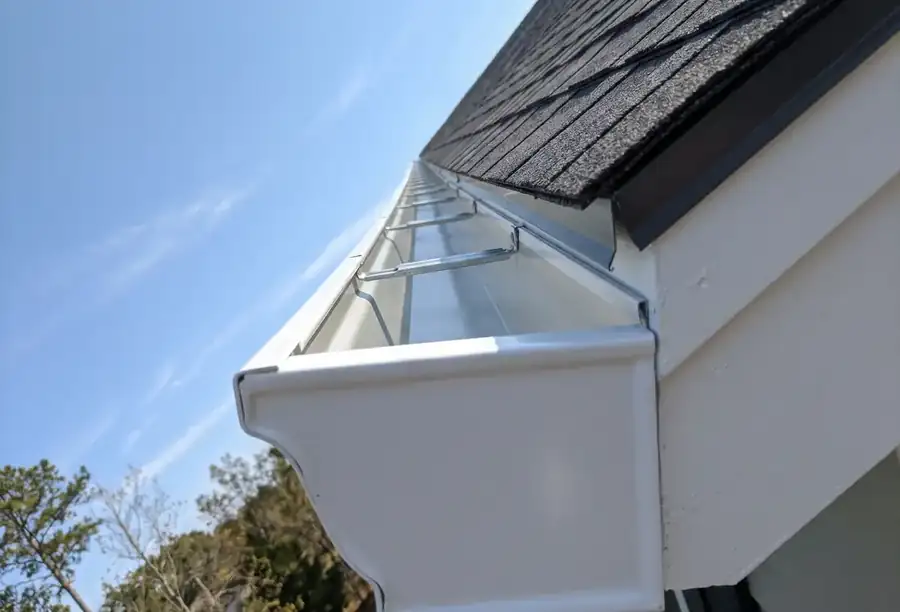
- Lift the gutter to the line and fix it with hidden screw-in hangers about every 2 feet.
- Reseal any joints disturbed by the work.
- Test with water to confirm it runs to the outlet.
When is the gutter itself the problem?
If the gutter is thin, dented or kinked along its length, or sectional with failing seams, re-hanging only goes so far. A new seamless run in 0.032-inch aluminum on close hangers is the lasting fix. See gutter replacement.
How can sagging be prevented?
- Use hidden screw-in hangers, not spikes.
- Space hangers about every 2 feet; closer under trees and with guards.
- Keep gutters clean so they do not carry wet debris.
- Fix drip edge and fascia problems before they soften the wood.
Related pages
How can I tell if the fascia is the problem?
Press the fascia behind the sag with a screwdriver. Sound wood resists; rotten wood gives, crumbles or feels spongy. Look for peeling paint, dark stains and swelling along the board. If the hangers have pulled out with wood fibers still attached, the board is soft. In those cases, re-hanging alone will not last; the soft section has to be replaced first. See fascia and soffit.
Why do some runs sag more than others?
Runs under trees carry more wet debris. Long runs between corners have more weight to hold. Runs on the north side of a house stay damp longer and can soften fascia faster. Runs below valleys take sudden, heavy loads of water. Contractors often add hangers more closely on those runs than on others.
What does a sagging gutter cost to fix?
Re-hanging is usually priced per run or per job, with fascia repair priced per foot if needed. It costs far less than replacement when the gutter itself is sound. Ask for the price in writing and how soft wood will be handled if it is found once the gutter is lowered.
What else should be checked while the gutter is down?
- The drip edge, so water enters the gutter rather than running behind it.
- The outlets, which can be enlarged at the same time.
- The downspouts and where they discharge.
- Whether guards would help keep the gutter light.